
Tunnelbana Art, the world's longest art exhibition
94 of Stockholm's 100 metro stations are decorated with painting, mosaics and sculpture by around 250 artists. Which stations are worth it and how to see them on one ticket.
Contents
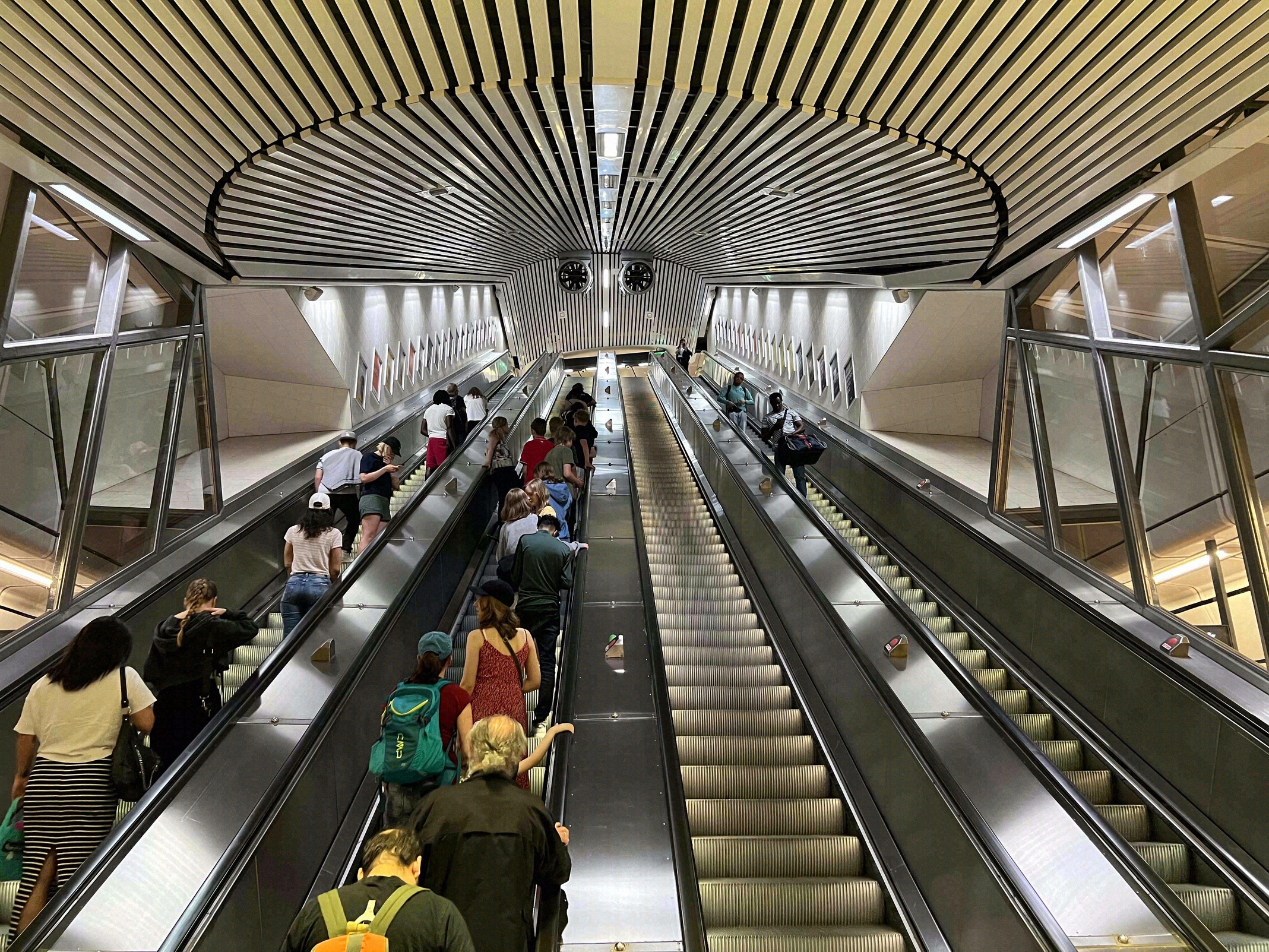
One of Stockholm's most original, and cheapest, sights lies underground. The Tunnelbana (metro) is not just public transport but a continuous, purpose-designed gallery, open to anyone with an ordinary ticket. This guide explains what lies behind the "world's longest art exhibition", which stations are genuinely worth the stop, and how to cover the highlights yourself in half a day.
What turns the metro into an art gallery
The figures come from the operator SL itself: 94 of the 100 stations are artistically decorated, the work of around 250 artists across a 110-kilometre network. It's that total length the title "world's longest art exhibition" refers to - SL's own description of the continuously decorated system, not an externally awarded prize. That said, it's a fair claim.
It all began in 1957 at T-Centralen station. Six decades of art have followed since, from painted rock walls to mosaics, sculpture, reliefs and tiling. The oldest works date back to the 1950s, and most of the spectacular rock-cut stations were created in the 1970s. Seven central stations also host rotating temporary exhibitions, changed one to four times a year, worth a second look if you're back in town later.
The rock-cut stations of the blue line
The heart of the metro art sits on the blue line. Here the stations were blasted straight into the bedrock, and rather than cladding the raw walls, the artists painted directly onto them. The result is a cave-like look found nowhere else.
- T-Centralen is the busiest hub on the network, and deliberately designed to calm things down. Per Olof Ultvedt painted blue-and-white vine and leaf motifs and worker silhouettes onto the bare rock in 1975; the cool blue tones are meant to take the edge off the rush.
- Kungsträdgården is the blue line's terminus and perhaps the most unusual station of all. Ulrik Samuelson designed it from 1977 (extended in 1987) as an archaeological grotto with genuine relics, including fragments of the demolished Makalös Palace, set against a red-green-white pattern. The station sits directly beneath the park of the same name, Kungsträdgården.
- Solna Centrum is the most dramatic of the rock-cut stations. Karl-Olov Björk and Anders Åberg painted a glowing red-and-forest-green mural about rural depopulation and environmental damage in the 1970s, a wall frieze roughly a kilometre long.
- Rådhuset is one of the deepest stations, rendered by Sigvard Olsson in rust-red cave tones.
- Tensta carries Helga Henschen's "A Rose for the Immigrants" (1975), a welcoming message to the district's multicultural population, quieter than the big rock-cut stations, but one of the most moving pieces on the network in content.
Highlights on the red and green lines
Away from the blue line, a handful of stations still merit a detour.
- Stadion (red line) is famous for the glowing rainbow that Åke Pallarp and Enno Hallek arched over sky-blue rock walls, a favourite photo spot.
- Tekniska Högskolan (red line, 1973) was designed by Lennart Mörk around technology, the four elements and the laws of nature, fitting for the neighbouring technical university.
- Thorildsplan (green line) breaks the mould entirely. Rather than a rock-cut station, it's an above-ground stop that Lars Arrhenius decorated in 2008 with coloured tiles forming pixelated retro video-game characters - Super Mario, Space Invaders and Pac-Man included.
If you'd rather skip the crowds, you'll find high-quality art in quieter stations too, such as Solna Strand, Mörby Centrum or Hötorget. T-Centralen and Kungsträdgården, by contrast, are the busiest, beautiful, but rarely empty.
How to do the tour yourself
The simplest way to explore the art independently is with an SL day ticket: one ticket lets you hop on and off as often as you like to take photos before moving on. Because the highlights sit so close together, a single day is enough, often just 1.5 to 3 hours. The blue line brings together most of the highlights.
A well-tried route runs from T-Centralen via Kungsträdgården back to Rådhuset, on to Fridhemsplan and Thorildsplan, with Solna Centrum and Tensta as detours further out on the blue line. Journey times between neighbouring stations are usually just 1 to 4 minutes, so almost all the time goes into looking around rather than travelling. For timing, aim outside commuter rush hours for both trains and photos; evenings and weekends see the emptiest platforms. For how the ticketing system works in detail, see the guide Getting around Stockholm.
Tickets, tours and orientation
You only need a valid public transport ticket for the tour. A single ride costs SEK 43 and is valid for 75 minutes including transfers; a 24-hour ticket runs to around SEK 180, a 72-hour ticket to around SEK 360, and a 7-day ticket to around SEK 470 (2026 figures, indicative, from a current secondary source). For an art tour with several stops, the day ticket is almost always the cheapest option.
You can buy tickets several ways:
- In the SL app "SL - Reseplanerare och biljetter" or online at sl.se.
- Tapping a contactless card, Apple Pay or Google Pay directly at the gates.
- At SL service centres and Pressbyrån kiosks, if you'd rather buy over the counter.
Guided options exist too. From June to August, SL runs free one-hour Art Walk tours in English, usually Tuesday, Thursday and Saturday at 15:00 from the SL customer centre at T-Centralen (Sergels Torg entrance), a metro ticket is required; tours run less often after August. There are also guided art tours with a museum educator from the Spårvägsmuseet (Stockholm Transport Museum) for around SEK 150, including museum admission. If you'd rather explore on your own, an unofficial art guide exists in the app "Linjekartor Stockholm", which uses the SL map but isn't run by SL. As far as we could establish, there are no official QR codes or audio guides on the platforms themselves, orientation runs via app or guided tour.
The art keeps growing
The collection isn't finished. In 2025 the blue line's northern extension to Barkarby opened, and several new stations are under construction, each with purpose-made art. On the Nacka branch, due to open by 2030, new art will include Sofia with "Utblick och riktning" ("Outlook and Direction") by Anna Lerinder, Sickla with "Direction Home" by Cilla Ramnek, and Nacka with "Windows" by Jesper Nyrén. At around 100 metres deep, Sofia will be one of the deepest metro stations in the world; Gullmarsplan is being expanded into a major interchange between the blue, green and red lines and the tram network.
Internationally, Stockholm's is the longest art metro, but not the only one. Naples' "Stazioni dell'Arte" display over 180 works by 90 international artists across lines 1 and 6; the Toledo station (Óscar Tusquets Blanca, 2012, with mosaics including work by William Kentridge) was named the world's most beautiful metro station by CNN and the Telegraph. Lisbon has more than 50 individually decorated stations with traditional azulejo tiles, and Montreal has had 68 since 1966, featuring murals, glass art and sculpture. So for beauty rankings of individual stations, others tend to come out ahead, but for the sheer scale of one continuously decorated network, Stockholm remains unmatched.