Food & Drink in Stockholm
Köttbullar, fika & archipelago fish
Husmanskost and köttbullar, the sacred fika with cinnamon buns, fresh archipelago fish in the market halls and a dense fine-dining scene, what to try in Stockholm and where.
Contents
Stockholm has become one of Scandinavia's most exciting food cities, and it operates on two levels at once. At street level sit hearty husmanskost and the daily rituals of fika and dagens lunch; above that, one of Northern Europe's densest fine-dining scenes. Eating out here isn't cheap, but it's worth it, and the best of it blends both worlds - Nordic produce, proximity to the Baltic and a pronounced love of seasonality.
Husmanskost, the Swedish classics
The quintessential dish remains köttbullar, Swedish meatballs served with mashed potato, cream sauce, lingonberry jam and pickled cucumber. Around it clusters husmanskost, hearty everyday home cooking, often cheaper at lunch than at dinner in many restaurants.
Two classics that actually originated in the city are worth knowing:
- Toast Skagen, buttered toast topped with crab or prawn salad, mayonnaise, dill, lemon and a dollop of roe. It was invented in 1956 by chef Tore Wretman, who improvised the dish during a regatta; the name refers to Skagen at the northern tip of Denmark.
- Gravad lax (gravlax), dill-cured salmon, classically served with a mustard-dill sauce and dill potatoes. The name literally means "buried salmon", recalling the old method of curing by burying and fermenting, later replaced by dry-curing with salt, sugar and dill.
The cheapest way to get to know the cuisine is dagens lunch, the widespread weekday set-lunch deal (usually Monday to Friday, roughly 11:00 to 14:00). In 2026 it typically costs around SEK 120 to 185, closer to SEK 100 to 125 at simple spots, and pricier at the smarter end in Östermalm. The price usually includes a main course plus salad bar, bread, a soft drink and often coffee, by far the best way to eat well on a budget.
Fika, coffee, cinnamon buns and a ritual
Fika, the Swedish coffee break with a pastry, is sacred, less a quick coffee-to-go than a deliberate pause in the day. The obligatory order is a kanelbulle (cinnamon bun), with the cardamom-spiced kardemummabulle a popular alternative. A few reliable addresses across the neighbourhoods:
- Café Saturnus in Östermalm is famous for its oversized cinnamon buns.
- Pom & Flora and Il Caffè on Södermalm represent the younger, much-photographed café scene; Il Caffè bakes in its own bakery.
- Lillebrors Bageri on Rörstrandsgatan stands out for sourdough, semlor and mazariner.
- In Gamla Stan, Café Kaffekoppen on Stortorget serves coffee and kanelbulle in a 17th-century vaulted cellar; next door are Café Krans and Café Kladdkakan.
Late summer brings its own flavour with kräftskiva, the crayfish party. The term dates from the 1930s, derived from a 19th-century upper-class crayfish ritual. Most parties happen on the first or second weekend of August, often outdoors, with paper lanterns, crayfish-shaped decorations, party hats, bibs and drinking songs. There's no fixed date, the season traditionally starts in early August and runs into September.
Archipelago fish and seafood
Stockholm sits on the water, and you can taste it. Fish and seafood from the archipelago and the Baltic are the city's most honest speciality, more on the boating side of things in the Stockholm Archipelago guide. Worth looking out for:
- Sill and herring, pickled, smoked or fried herring in countless variations, from mustard to dill to blackcurrant.
- Strömming, fried Baltic herring, classically served with mashed potato.
- Räksmörgås, a generously topped prawn sandwich, a Swedish lunch classic.
- Röding (Arctic char), smoked fish and smoked crab from the archipelago.
- Surströmming, fermented herring, is a late-summer speciality mostly associated with northern Sweden, more a dare than an everyday dish.
A handful of well-known restaurants serve this authentically, among them Wedholms Fisk, Sturehof, B.A.R. and Melanders Fisk. For smoked fish straight from the archipelago, head to the family-run Nynäs Rökeri, an award-winning smokehouse with its own restaurant attached. But for the freshest choice of all, go to the market halls.
Market halls - Östermalms Saluhall and Hötorgshallen
Two historic market halls bring together the city's best fresh produce and also make for an easy lunch stop at one of their counter restaurants.
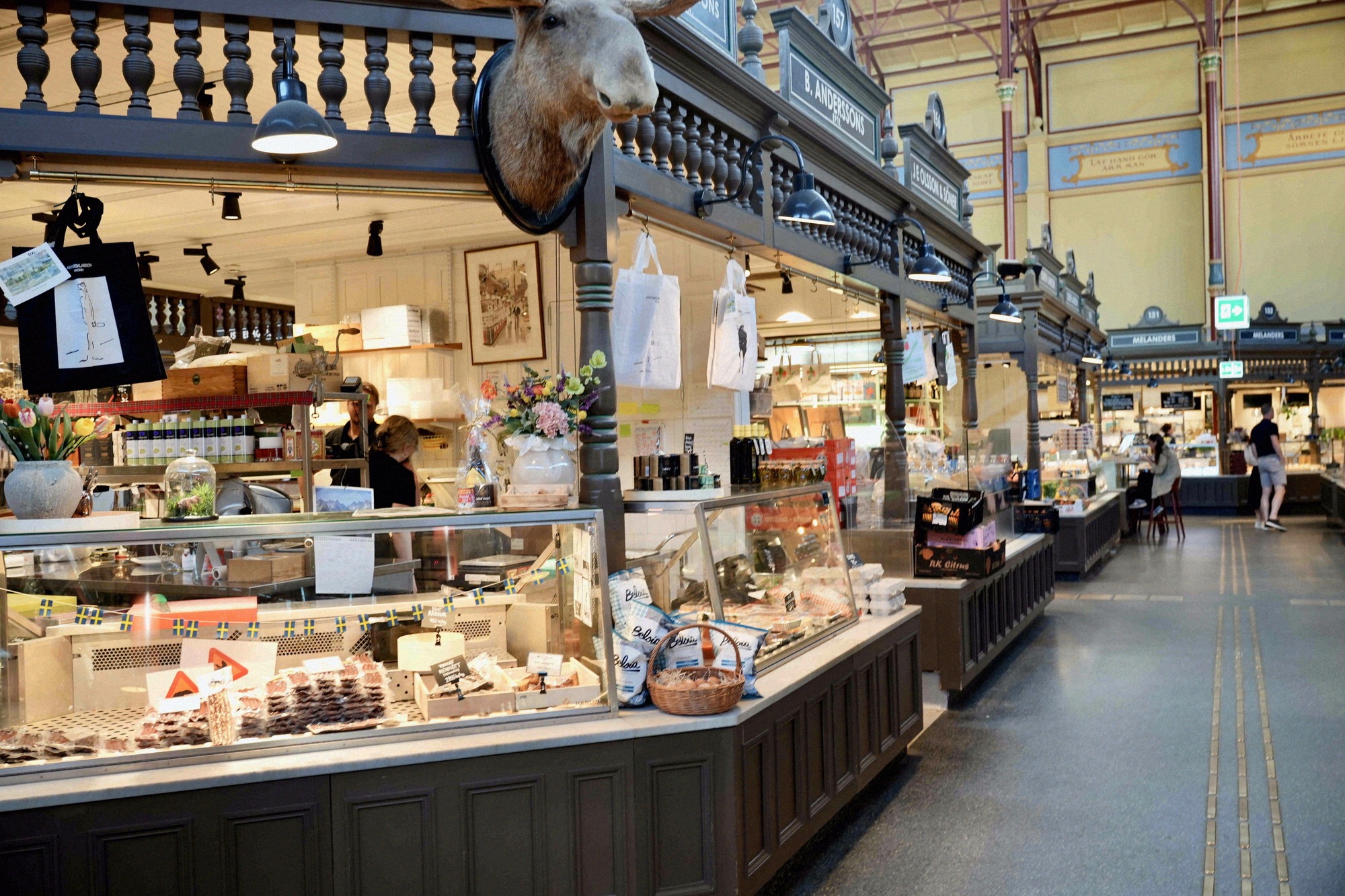
Östermalms Saluhall (Nybrogatan 31, on Östermalmstorg) is the grander of the two, a brick hall dating from 1888. Its most famous stall is Lisa Elmqvist, both a fish and seafood merchant and a restaurant. In 2026 it's open Monday to Friday 09:30 to 19:00 and Saturday 09:30 to 17:00, closed Sundays; individual restaurants inside stay open later in the evening. The Östermalmstorg metro station is right on the square. Which counters are worth it, and when it gets busy, is set out on the market hall's own page.
More down-to-earth and more central is Hötorgshallen in Norrmalm on Hötorget, the current building dates from 1958 and houses around 40 shops over two floors. The lower floor is lined with fishmongers, fish restaurants and bistros. In 2026 it's open Monday to Thursday 10:00 to 18:00, Friday until 18:30 and Saturday 10:00 to 16:00, closed Sundays; the lower floor closes an hour earlier each day.
Fine dining, the Michelin scene
According to the 2026 Michelin Guide, Stockholm has around a dozen starred restaurants, ranging from one to three stars. The new stars for the Nordic countries were awarded on 1 June 2026 at the ceremony at the Tivoli Concert Hall in Copenhagen. Reservations here need lead time, at least a month at the top address.
- Frantzén in Norrmalm is Stockholm's only three-star restaurant and was Sweden's first, in 2018. Creative, Nordic-Asian-influenced cooking in a renovated 19th-century townhouse. The tasting menu costs from SEK 4,800 per person excluding wine, and the private-dining menu SEK 5,500. Bookings are released on the 1st of each month at 10:00 for the following month.
- AIRA on Djurgården holds two stars (its second since 2023) and pairs seasonal Nordic cooking with sea views; Tommy Myllymäki runs the kitchen.
- The one-star houses span everything from Japanese to open-fire cooking to opera-house history, among them Sushi Sho (a 15-course sushi menu), Ekstedt (everything cooked over open fire, no electric stove), Operakällaren at the Royal Opera House (open since 1787), plus Celeste and Dashi (both starred since 2024), ergo. (since 2025), and Etoile, Nour, Adam/Albin and Seafood Gastro at the Grand Hôtel.
Individual one- and two-star houses usually only share exact menu prices directly with guests; Stockholm generally has no strict dress code, and smart casual is a safe choice.
Eating plant-based and paying with ease
Plant-based cooking is firmly established in Stockholm in 2026, right up into fine dining. Växthuset, for instance, offers vegan Scandinavian fine dining with three- or five-course tasting menus built consistently around Nordic preservation techniques, fermenting, curing, smoking. More than 100 restaurants across the city now offer a substantial vegan menu, and plant-based options appear on almost every menu.
Paying is straightforward: Sweden is largely cashless. Restaurants and cafés almost universally accept contactless cards, and cash plays only a tiny role. The Swedish payment app Swish is mainly used for splitting the bill among locals, but it requires a Swedish bank account and BankID and is usually unusable for foreign visitors, your Visa or Mastercard works everywhere instead.
If you want to combine eating with sightseeing, find the right order of play in the Stockholm's attractions at a glance; for when kräftskiva, the market halls and archipelago fish line up best with the seasons, see the best time to visit guide.